U.S. Congressional Delegation Leaves Cuba with High Hopes
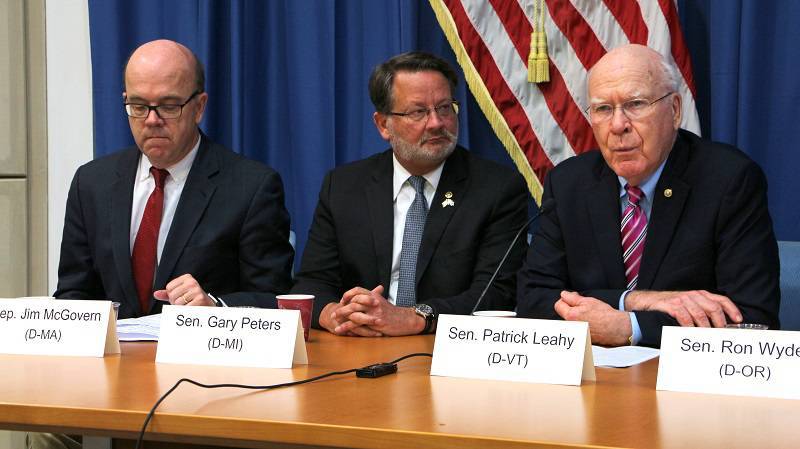
A U.S. congressional delegation from the Democratic Party wrapped up Wednesday a five-day visit to Cuba with a press conference held on the premises of the embassy of the United States of America in Havana, Cuba.
The congressional delegation was headed by Senator Patrick Leahy of Vermont. The other members of the delegation are Senator Ron Wyden, of Oregon; Senator Gary Peters, of Michigan; Representative Jim McGovern, of Massachusetts, and Congresswoman Susan Davis, of California. Congresswoman Kathy Castor, of Florida, was part of the delegation, but departed Cuba a couple of days earlier.
Senator Patrick Leahy, a longtime Cuba visitor and a staunch advocate of better relations between Cuba and the U.S., recounted his efforts and those of other members of Congress in the U.S. to seek more engagement with the Cuban people, and how those endeavors have now taken a few steps back following President Donald Trump’s decision to dismantle part of the rapprochement made during President Barack Obama’s second term.
Senator Ron Wyden referred first to the incidents that have affected the health of the U.S. diplomatic personnel stationed in Havana and that eventually prompted the U.S. State Department to order the withdraw of more than half of American diplomats in Havana and their relatives.
The alleged “sonic attacks” have shut down all consular services in Havana since September last year, forcing Cuban nationals seeking visas to enter the U.S. to travel to third countries in the region, especially to Colombia, a decision that makes the visa application process far more expensive for the Cuban people.
“On the issue of our diplomats. Each of us puts health and safety first and after a long session with the Cuban authorities yesterday, I believe we need to put our best minds on this and hope to get this resolved, so that our two countries can progress and move forward together,” Senator Wyden said in his opening remarks.
“At the same time, it’s important for the Trump administration to stop falling back on cold-war policies that didn’t make sense many decades ago and make even less sense now,” Mr. Wyden went on to say as he spelled out the many fields both Cuba and the state of Oregon could work on together.
For is part, Rep. Jim McGovern admitted he had no idea what happened to U.S. diplomats in Cuba and that even though the safety and protection of the American personnel overseas is a primary concern, he believes it was a mistake for the U.S. government to cut back on the American diplomatic personnel in Cuba and also required the Cubans to cut back on their own personnel in Washington D.C.
“Cuba is changing. Soon you will elect a new president and likely experience a generation shift in leadership, and regrettably at this historic moment in Cuban history, the U.S. engagement is limited,” Mr. McGovern added as he lashed out at the travel advisory the U.S. State Department issued against Cuba a few months ago.
U.S. travel to Cuba was steadily on the rise after both countries decided to restore diplomatic relations back in December 2014. U.S. airlines and cruise lines started coming to Cuba, but now President Trump’s new policy on Cuba has made a significant dent on the number of Americans that travel to the Caribbean island.
And now that the March 4 deadline for the U.S. State Department to determine whether the cutback of the U.S. diplomatic personnel in Havana could be permanent, these members of Congress are willing to let their constituents know that Cuba is indeed a safe country for Americans to visit.
“I’ve traveled to Cuba with my wife and I wouldn’t endanger her in any way, and she’s here with me. I took our 13-year-old granddaughter. She’s here with us and I would have never brought her to Cuba if I would have known she could be in danger,” Senator Patrick Leahy told the press gathered at the U.S. embassy in Havana.
On that same topic, Rep. McGovern took the floor to point out that supporting families is one of the fundamental values of the United States, so preventing the Cuban people from traveling to the U.S. to visit their relatives there is a betrayal to those very values.
In its meetings with the Cuban authorities, the U.S. congressional delegation brought up the importance of getting the Cuban currency unified and put an end to the 15% tax Americans pay to exchange dollars in Cuba. According to Senator Ron Wyden, Cuban authorities told the delegation repeatedly that “this is the year to get it done, to unify the currency in Cuba.”
Since 1994, when the U.S. dollar was allowed to circulate freely in Cuba, the island nation’s economy has been marked by a dual-currency system in which workers are paid in Cuban pesos (CUP), yet they need to buy groceries and other staples in Cuban convertible pesos (CUC), which currently holds an exchange rate of 25 to 1.
The delegation arrived in Cuba on Saturday, February 17. While in Cuba, they met with U.S. and Cuban officials, officials of other governments, and Cubans in the emerging private sector to discuss the presidential transition in Cuba, U.S. and Cuban investigations of health issues involving U.S. government personnel on the island nation, and cooperation on maritime security, narcotics and human trafficking.
During the visit, they also tackled migration issues, the impact of the withdrawal of U.S. Embassy and Cuban Embassy personnel and revised Treasury Department regulations on U.S.-Cuban relations, as well as opportunities for further cooperation on public health, law enforcement, scientific, environmental, commercial, educational, cultural, and other engagement with Cubans.