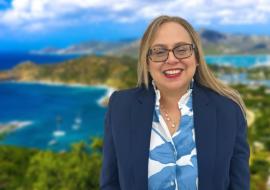
Amada Luisa Rios Alvarez. General Agent of the Naval & Industrial Company


Q- How long has this company been based in Cuba?
A- Naval & Industrial is a Panamanian company that set up shop in the Mariel Integrated Development Zone five years ago, even though it’s been registered in the logbooks of Cuba’s Chamber of Commerce since 1990.
Q- Can you give our readers some insight of what this company is all about?
A- Naval & Industrial is currently providing specialized services to midsize and large ships; we take full responsibility for the vessels’ mechanical status, I mean, the machinery, the main engines, the thrusters and other equipment. We also provide teams of workers that deal with tubes and pipes. I must say that we conduct all works when the ships are in the water, especially when the vessels are operating. That explains why this job takes so much responsibility. I can assure you that we’ve never stopped a ship to have it repaired because all works are always done in line with the crew’s requested schedule.
Q- What are the main products offered by Naval & Industrial?
A- As we speak, the company represents the exclusive distribution of International Paint, a marine product that ranks high in the world and has been used in Cuba for the past three decades. We’re now dealing with a world-class product, Intersleek 700, that can be applied both on steel, aluminum and plastic, and lasts five years before another fresh coat is given, according to what research studies have revealed. In Cuba, for instance, this particular product has been applied in the gunboats used by Cuba’s coastguards. Six of their cutters have so far been painted with this product. I must say this process has been undertaken in a very coherent way. Thus, we’ve been able to see how Intersleek 700 does in the tropics, thanks to its application in Cuban coastguard cutters. On the other hand, we’ve also tried it out in the hydrodynamic chamber of the island nation’s Navy, and the outcomes have been great.
Q- Can you tell us about your company’s latest projects in Cuba?
A- Right now, we’re juggling a number of projects and initiatives, such as a partnership plan with the Πmesco Special Mechanical Group in an effort to design parallel products. One of them is the Travel Lift, designed for yachts of up to 30 tons. We’re considering the possibility of setting up a boat repair and paint center for that kind of boat. In addition, we’re working hand in hand with that group to initiate the building of recreational boats, fishing boats and tourism-oriented vessels. That’s plan is basically linked to the Valdes Reyes Shipyards, owned by IImesco.
I’d like to say that we’re all in high spirits about this particular project that, in our view, opens ample possibilities in the shipbuilding business for Cuba, an island that has enthusiastically developed nautical activities and water sports for more than forty years. Things are really looking up for our company because we can now provide services to yachts that come to Cuba for sport events and regattas. Their skippers are sometimes eager to get to Cuba to have their boats fixed or refueled before sailing on to their final destinations.
Q- Is there any other initiative in this direction?
A- All of the above should be complemented by the naval hardware store that we’re just about to open on Autopista Highway and the corner of 17th Street. This naval hardware store will make yachters rest assured that they can anchor in this country and find anything they might need for their boats, you know, the kind of stuff they usually buy in any seaport around the world. I’m talking about certain products that are unavailable for boaters in Cuba right now, items and accessories linked to this realm of yachting and boating.
The company’s logistical know-how is huge because we’ve been operating in all Cuban seaports for the past fourteen years. Our teams are dispatched in keeping with the requirements of a certain boat, and depending on the port and the place of the island they’re docked in.