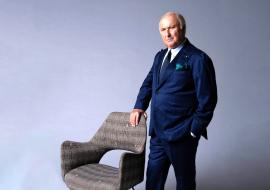
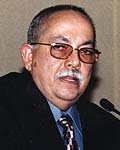
Dr Obel Garcia Baez. Director General “Camilo Cienfuegos” International Retinitis Pigmentosa Center

Q: Can you describe what the main features of the “Camilo Cienfuegos” International Retinitis Pigmentosa Center are?
A: The “Camilo Cienfuegos” International Retinitis Pigmentosa Center opened on June 20, 1992 under the leadership of our unforgettable Prof. Orfilio Pelaez Molina –who thought up the advanced therapy treatment aimed at reversing the disease known as retinitis pigmentosa that in the past used to doom people to be blind for good.
Patients suffering from this particular ailment have extremely blurry sight, dimmed illumination and a piecemeal loss of the peripheral visual field all the way to total blindness.
When we get down to this kind of therapy, cure is not the ultimate goal. We’re currently working with an array of possibilities in genetics because this is a degenerative progressive disease we’re talking about. We’ve watched over a thousand patients under our treatment and these are the results we’ve come up with: the disease has stopped in around 76 percent of our patients; 16 percent of them have observed an improvement in the peripheral visual field, and the remaining 8 percent has seen no progress at all.
This center came into being driven by the huge demand of lots of people living in other countries who somehow learned about the successful therapeutic treatment created by Prof. Pelaez. That’s how the center started admitting a good deal of patients coming from overseas. As we speak, the center counts on 70 rooms outfitted with one bed for the patient and another one for the companion.
Q: Is there any other center in the country providing this kind of therapy?
A: There’s a center in each and every province of the country to treat patients suffering from this disease.
This nationwide program has allowed us to register, diagnose and treat a grand total of 4,123 patients with this kind of therapy. For instance, there are provinces with over 27 patients –both children and teens- who do not attend special schools for the handicapped. As you can see, this is tremendously important from a social standpoint.
This control policy permits us to study and assess each family member at a time in each and every one of the centers we’ve got scattered across the country.
When Prof. Pelaez’s program teed off back in 1990, the disease’s ratio comprised 2.1 patients in 10,000 inhabitants. Now it’s grown to 4.1, but that’s the result of the family doctor policy that also plays a significant role in the outcomes we’ve achieved so far.
As I said before, this international center was born out of the success attained by the nationwide program, and that’s no doubt a big feather in the Cuban health care system’s hat.
Q: Who’ve been treated in this center?
A: The center has provided assistance to more than 6,000 patients hailing from 80 different countries around the world. The biggest chunk of those patients comes from Brazil, Argentina, Italy, Portugal, Mexico, the U.S., the Netherlands, Venezuela and other nations.
Q: What kind of equipment is the center outfitted with?
A: Right now, we’ve got cutting-edge technology here, the latest high-tech equipment money can buy anywhere around the globe. On the other hand, our specialists are pretty well trained and keep delving into the latest technological breakthroughs all the time. They take part in national events and attend the world’s finest gatherings dealing with eye care. At the same time, they exchange views with peers from other countries who visit our center.
There’re other nations doing research on this particular disease –the U.S. is a case in point- where other immunology-oriented therapeutic treatments are applied. I can mention the treatment thought up by Colombian Prof. Vasquez Posada, based on the decompression of the optic nerve, and many other research studies being conducted in the genetic field.
Q: Has the center scored any favorable economic benefits?
A: In that respect, the center’s been doing good. We’ve just made $2 million this year for a 115 percent surplus. From its grand opening to date, the center had churned out $38 million, with half that money going straight into the nation’s coffers. We’ve always accomplished our economic plans. We’re working with an 80-plus percent occupancy rate and growth prospects are also looking good given the huge demand that we have.
Q: Any special feeling towards the Quality Prize your center’s just won?
A: I think we’ve got some prize talking to do. First of all, we won the Quality Prize granted by the Cubanacan Group back in 2000. Last year, we grabbed the Corporate Excellence Award bestowed by Havana’s local government. Now we’ve been honored with the Quality Prize given by the Republic of Cuba. And this particular award is the result of the daily hardworking, endeavor and dedication of our scientists and employees.
We’re just about to implement the ISO 9001 standard. We’re bending over backwards to pull this one off and we’re working devotedly to get the Iberian-American Quality Prize.
Q: Main projects in store?
A: We’re trying to take our money contribution to the country one peg higher this year in order to funnel that money into the country’s health care system and into our affiliate centers all across the island.
In the near future, we’re going to hold the First International Meeting on Refractive Surgery (EXCIMER LASER) scheduled for June 26 to 28 in Varadero. There, we’ll have the presence of some of the world’s most prestigious ophthalmology professors, plus 200 eye care specialists from abroad and, of course, our Cuban experts. This event alone speaks volumes of Cuba’s ophthalmology and the international recognition this center has garnered through the years.
Our major challenges on the road ahead this year, well, we’re trying to improve our services, raise the technical and scientific level of our experts, and keep on doing research day in and day out.
On the other hand, one of the center’s major achievements is the preservation and development of Prof. Orfilio Pelaez Molina’s therapeutic technique. That’s a way to pay tribute to this great Cuban scientist.