FITUR 2004 Underway in Madrid, Spain
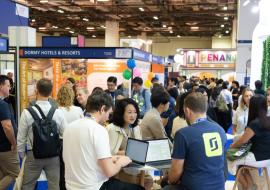
The 24th edition of the International Tourism Fair (FITUR), the world’s first major travel event of the year, got cracking Wednesday at the Juan Carlos I Fairgrounds in Madrid with a record-setting turnout.
Some 10,000 companies from 170 countries will show off their breakthroughs and products displayed all over 77,000 square meters, 2.5 percent more exhibition space than in 2003. For the first time ever, the IFEMA Fairgrounds will be crammed up by exhibitors that will crowd the compound’s 150,000 square meters.
As a matter of fact, organizers indicate such a massive attendance underscores the international travel industry’s confidence in this particular event as one of the finest business and trade fairs worldwide.
The relevance of this year’s FITUR lies in the dramatic increase of international attendance, up 11 percent from 2003. And this growing turnout has forced organizers to open Pavilion 2 to accommodate foreign exhibitors, coupled with traditional Pavilions 4 and 6.
There are some newcomers in the 2004 FITUR: Benin, Cote d’ Ivory, Jamaica, Latvia and Malta. In addition to this four-pack, Slovenia will come to the fair with a number of national companies, while the Caribbean Hotels Association (CHA) will also have its big break as a regional institution.
Spanish companies will flaunt their roots in the field of travel industry, taking pavilions 3, 5, 7 and 9, while pavilions 8 and 10 will be reserved for local transportation companies, wholesalers, tour operators and hotels.
Planners have also made some room for international hotel chains and foreign associations in Pavilion 8. Roughly 75 percent of the fairgrounds’ total surface will be taken by Spanish firms, up 11 percent from the total space local companies took in 2003.
As to the breakdown of sectors participating in the 2004 FITUR, hotels will comprise 47 percent of the total, followed by organizations and institutions (23 percent), travel agencies and tour operators (14 percent), transportation enterprises (7 percent), service providers (6 percent), mass media (2 percent), and congress and incentives (1 percent).