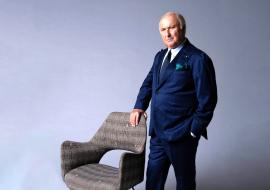
Guido Vitali. Festival Cruises´ Area Sales Manager for Latin America


Q- Where did you start your professional career?
A- That was in Italy back in 1984. I’ve worked in many countries, except in Asia. In Italy, I worked for airports as marketing manager and for quite some time now I’ve been working for Festival Cruises, a Madrid-based company.
Q- Then we may say that you sort of jumped out of the sky into the sea. What similarities and differences do you find in them?
A- There are many similarities. Working for air companies allowed me to gather great experience and expertise in the sale of tourist products, and applied all that in the realm of cruises. I may say this has made my job easier in a way.
Q- But twenty years working for an air company builds up some faithfulness toward the sector. In your case, however, there was a change of country, a change of market. What prompted those changes?
A- I always felt strongly drawn to Spain, a country that has evolved dramatically since 1975. It joined the European Union and it rapidly managed to be in sync with the continent’s economic and social indicators. I believe these are remarkable achievements. As to Latin America, I also worked in Argentina for half a dozen years. I’ll tell you what; I’ve found a very encouraging way to both live and work.
Q- You got a Ph. D in Political Sciences and you’ve also taken marketing courses. How have these two elements merged in your current job?
A- It’s very important to have academic training and experience in entrepreneurial management at the same time.
My studies of International Law and International Affairs at the School of Political Sciences (LUISS) –one of Italy’s top colleges- have certainly been a great help to be a more resilient, open-minded man who knows how to cope with a variety of cultures and situations. That’s by far the first condition to be a winner. You must listen to and understand the customer rather than trying to ram your views and products down his throat.
At LUISS, back in my first youth and with the help of my professor, I took a number of courses and seminars between 1980 and 1982, chiefly on the conflicts in the Middle East.
My stint at the Wharton Executive Development Program in 1994 has been the most enriching experience I’ve ever had for my future professional development in the many companies I’ve worked for and I’m still working for. That meant to be a sea change, a permanent about-face, something I still treasure way down inside almost ten years later after leaving Philadelphia University behind. That’s absolutely one of the world’s finest Business Schools. Make no mistakes about it.
Q- What’s been the toughest situation you’ve been bound to face up to: the 9/11 crisis, the wars in the Middle East or a bobbing dollar whose peaks and valleys have dragged the European market into a recession?
A- As you said, all companies linked to the leisure industry, whether it’s a hotel, an airline or a cruise company, are exposed to negative perceptions and distrust on the part of passengers in situations like the 9/11 attacks and the wars in Afghanistan and Iraq. Fortunately, we’ve branched out our businesses in different markets worldwide. We’ve got offices in Europe, in the U.S., Asia, the Caribbean, and this has left us almost unscathed and ready to carry on in developing new markets like, say, Latin America.
Q- Can you say that among the world’s biggest cruise companies, Festival has weathered these storms better than anybody else?
A- We’re aware of what our market reality is and we can say a hundred percent certain that the overall crisis that hit tourism brought about insignificant effects on our company. You bet that’s owed to the quality of our product
The cruise market is undergoing a huge expansion everywhere, chiefly in Europe. Moreover, some recent studies prove this trend is really holding water.
In recent years, Festival Cruises, by offering a top-notch, classy and very European kind of product, has been able to claim its share of the market and downplay the limited effects of the ongoing international crisis, especially in Latin American markets.
The huge success of our vessels and the strong appeal they have in the European public are no doubt the strongholds of Festival’s strategy for the near future.
I should also say that our occupancy rates are doing pretty good and that we continue looking ahead of us, staring at the next Caribbean season that’ll take place from December to April.
Q- What tells Festival Cruises from those competitors in the market that have come together to form a mighty power lobby?
A- Festival Cruises is strongly committed to a commercial and product development project that’s beginning to pay off. A quality product is the name of the game for us. It’s no coincidence –and I’m telling you this just as an example- that so prestigious an international company as Hilton Hotels has picked our group to set up shop aboard our Premium liner. This is a new product called “Hilton Floating Resort on Festival Cruises.” They chose us, not any other competitor stationed in Europe.
Q- What policy is Festival going to implement in Latin America and what’s going to be Guido Vitali’s responsibility in that new approach?
A- The first thing we’ve got to do is put the company on the map because Latin America remains a tough market for us. We’ve poured a tremendous amount of efforts and time into this, so we must begin with salespeople. We want everybody to learn about our fleet, the schedules and the timetables, the features of our ships and the philosophy of our company. Then we’ve got some hardworking to do with both our dealers and customers.
Q- What kind of investment are you going to make to bring this off?
A- The most important investment is already made. For the upcoming season, we’re going to have two different vessels –the European Vision and the Caribbean- cruising from Santo Domingo on a weekly basis. The Caribbean is going to remain there from December all the way to mid August. We’re making big-time investments in a good deal of the ship’s cabins and all of this is done for the sake of this market’s development.
Of course, the role that such neighboring nations as Mexico, Colombia, Venezuela, Brazil and all of Central America have to play is really big. We’re keeping our eyes glued on them because it’s a whole lot easier to sell a cruise ticket to a passenger from the region than talking a European into taking an 8-hour flight from his country only to hop onboard a deluxe liner later on.
Besides, we’ll be attending the two most important tourism fairs in the area, scheduled for Mexico and Brazil.
Q- Are you eying Chile as a potential market?
A- We’re very interested in it. This is an excellent market based on solid economic grounds. We’re very interested in the so-called Southern Cone, that is, Argentina, Chile and Uruguay.
We’re very much aware of Lan Chile’s recently opened flight that hooks up the country with Santo Domingo and Miami. Therefore, chances of getting connected with our cruises in the Caribbean are far bigger right now.
Q- Whatever happened to the collaboration with Cuba to keep one of your cruises stationed in Havana?
A- Festival is the only cruise company in the world whose ships sail in Cuban waters. For us, Cuba is an important case of reality check. In the winter of 2003, a vessel owned by Festival Cruises will dock in a Cuban pier.
The Caribbean continues to dock in Santiago de Cuba. The city is contained in our 2003-2004 timetables, so we’ll continue working with Cuba. We’re convinced of that destination’s kindness and the good-heartedness of its people. We’re equally weighing our chances of further strengthening our presence and commercial offer in the Caribbean Sea, and mainly in Cuba.
Q- U.S. laws bar any ship entering a Cuban port from docking in an American seaport later on. How does this legal provision affect Festival Cruises?
A- This matter ought to be construed from a commercial standpoint. Miami is coming apart at seams with offers and competition there is fierce. I really don’t know whether it’ll be better to dock in Miami. You bet the U.S. market is important, but we offer a European product. It may be easy for Latin American customers in general, but not so for U.S. travelers.
Our ships and U.S. vessels operate under different approaches. Once you climb onboard our liners, you know immediately what European liking is all about. European-style classiness and quality are so important that even our marketing motto reads: The European Cruise Masters. That explains how our marketing policy is actually like. Furthermore, when you talk about Cuba and North America, you must bear in mind that there are other North American markets, like Canadians, that do travel to the island nation. By the way, we’re very pleased with the numbers we’re posting, I mean, the amount of Canadian passengers traveling to Cuba. We’ve got an office in New York City and the results have been very positive.