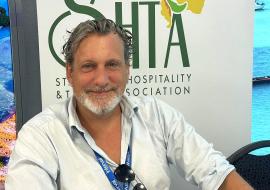
Rafael Gutiérrez Niebla. Outgoing chairman of the Pan American Conference of Hotel, Gourmet and Tourism Schools
Mexican-born Gutierrez Niebla, up to now at the helm of the CONPEHT (acronym in Spanish) gathering 70 institutions in 21 countries, warned about the shortage of resources in tourism education due to the lack of trained teachers. Roughly 80% of tourism-related professors in Latin America are honorary people who come and go teaching on techniques and giving topic updates on the sector, yet they don’t have a methodological formation.
Being competitive, the exec said, requires institutions to count on the necessary resources for people to get training courses and teaching techniques in the first place, while using all accreditation and certification tools and processes both on programs and plans, as well as from the teaching professionals.
The CONPEHT Chairman is confident that tourism education could eventually be competitive in Latin America because “we have lots of things you don’t find in other places, and above all, because in general terms we make wonders without the proper resources.”
Information –he said- flows plentifully these days through the Internet and all those information superhighways can be used to download pieces of information only the First World used to have in the past. That’s where we must do our work by focusing on research, both on the tourism phenomenon and the academic and teaching phenomena, Mr. Gutierrez Niebla pointed out.
Mr. Niebla went on to speak on the current boom in opening tourism schools and said in many countries centers of that kind are mounted in garages and professors there brag with not having to teach Mathematics because they render that subject matter as completely unnecessary. On that particular issue, the expert wondered what company on earth today does not need to keep a financial spreadsheet or at least manage a budget.
A market research without statistics doesn’t work, he added in referring to the need to standardize tourism education. “That’s why the accreditation process is so important. I’m not speaking about ratification dealing with basic contents. From that notch up, whatever is added can only give the institution a much better name.”
Inquired whether this situation could turn tourism education into a elitist teaching activity, Mr. Niebla replied the point is, in the first place, that training of professors and students is not an activity as such, but a phenomenon that must be tackled through a systemic and contingency approach that takes into account what really matters for the community.
As far as schools are concerned, he averred vocation is nitty-gritty because sometimes “these kids think they’re going to become tourists and make a big mistake, or they believe that’s education only for women without taking into consideration that in macho societies like most Latin American nations, it’s hard for a father to send his daughter to college to be a hotelier. If that girl likes banquets and events, and his father doesn’t allow her to go out at night, the point is she’ll wind up working in a different industry at the end of the course.”
It’s equally necessary to make people aware of what tourism is all about and push that course to a top-tier level in education, the same as medicine, law and communications.
As to Cuba’s leisure industry, Mr. Niebla said it has grown way too fast, and that’s a challenge that needs to be worked out. FORMATUR is there to meet the sector’s requirements as far as well-trained human resources are concerned, I mean, people trained on the techniques and the concepts at all levels, from the operator all the way up to the manager. That current challenge will be ironed out through the experience they already have in teaching, he added.
With college degrees on Tourism at the Hispano Mexicana University and Philosophy at the UNAM, Mr. Niebla is a dry-behind-the-ears professional with over 20 y