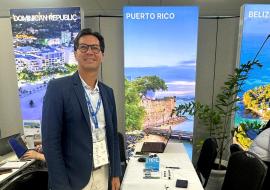
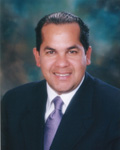
Reyson Pimentel. Representative of Coral Hotels and the CTO Chapter in the Dominican Republic

Q.- Reyson, we come from a long way back and we’ve seen you in all events. You’re the most active traveler and the man who pours more efforts into the hotel group that you represent and for the sake of the Caribbean all around the world. We know you’ve been awarded with an acknowledgement plate for your work in this office between 2001 and 2002. That’s why we’d like you to tell us what your responsibilities are and what you make of the CTO today as an organization.
A.- Basically, we attend events as affiliated members of the CTO and you bet we’re trying to keep a world-level participation in those meetings. That’s my responsibility: to guarantee the presence of our company, an enterprise that runs a variety of products. That includes the Coral by Hilton All-inclusive Resorts, the Guavaberry Golf & Country Club, which is a gorgeous golf course and summertime house getaway with a beach club just half-an-hour drive from the city of Santo Domingo, plus the Malecon Center whose management is supposed to be handed over soon to a world-class hotel group. Basically, the role of the CTO in the Dominican Republic –even though its full-time membership is yet to be determined- has been and will be very important. I wish the current situation could be worked out. I believe we’re caught in the middle of a very complicated situation because this has been a relationship that’s taken a number of peaks and valleys. Yet the role of the CTO has been fairly important in the development of tourism for the Dominican Republic, chiefly when it comes to training and delivering sustainable tourism programs.
Q. The CTO has a new policy in place right now and I think –during the Caribbean Week- there was a pretty tough and thorny meeting focused on the CTO’s work in the promotion of the Caribbean. What can you tell us about it?
A. Well, I think that, as it happens in every organization, time has come for the CTO to review its structure as an organization. I guess this is something most members of the board of directors are claiming for. They obviously receive the suggestions and opinions of the CTO’s thirty three member states.
I believe we’re living highly dynamic times riddled with breakthroughs of all kinds. The CTO has bent over backwards in recent years, yet there’s still a long way to go and those were the topics the debates were centered on during this event. I mean, the kind of decision-making that is required right away. This is something that’s going on in all organizations and you bet the CTO is no exception to the rule.
Q. What’s the situation in terms of representation within the organization, I mean, within non-English-speaking member states?
A. Well, both my colleagues in Puerto Rico and myself –there’s not a Cuba Chapter right now- believe there are things that must be done. One of those things is the need to work out the problem of language plurality, turn the CTO into a multilingual organization because we’re seeing problems in meetings when there’s a heavy turnout of Hispanic attendants, for instance from the Dominican Republic, from Cuba and Venezuela.
The CTO has gone at great lengths to accept Cuba as a full-member of the organization, but I think we must continue pressing on the CTO to be an institution that represents the entire Caribbean Basin.
Q. The outing of the Mexican Caribbean and Mexico as a CTO member, does this in any way affect directly the non-English-speaking Caribbean?
A. Absolutely. I believe this was the first hint, the very first wake-up call for the organization, a sign that something had to be done, especially when you know all along that Mexico, the Dominican Republic and Cuba are three underpinnings in the Caribbean. If the CTO is supposed to be an organization that represents tourism in the Caribbean as a whole, then we must understand that, under those same principles, the CTO cannot be exclusively an English-speaking organization. The CTO must knock down all language barriers.
Q.- Could people from such countries as, say, the Netherlands Antilles, made up of multilingual persons in general terms with a diversified cultural background, be the directors and representatives of the massive opinions of a global Caribbean?
A.- We must make sure there’s a chapter in each and every one of these islands with a say within the organization, as we’ve been trying to do in the Dominican Republic. As we speak, there are only five chapters in the Caribbean. The Jamaica Chapter has been going on and off, though it’s pretty active right now. St. Kitts & Nevis will be coming aboard soon. We also have one in Grenada, Puerto Rico, the Dominican Republic and another one in Barbados. The latter serves as the CTO headquarters. You bet we must have this kind of influence on the part of multilingual islands, as well as on the part of those islands where tourism has made significant headway. That explains why many executives and representatives are either bilingual or speak more than one language.
Q- What’s your opinion on the possibility of opening a Spanish chapter in the European market, a region where the CTO has none?
A.- I think the CTO’s structure in Europe should work in a different way to the one it does now. The European chapters are affiliates of the central headquarters and do not stand for voluntary management as in the rest of the countries. Therefore, this means that maybe their work should hinge on simply monitoring things, just like any tourist representative and unlike organizations that could grow symbiotically.
Q.- What could be Mr. Pimentel’s contribution, with his global opinion and expertise of all European countries and international fairs he attends, to make the CTO improve its presence and attitude toward the many European markets that one by one make up a community of ideas and traditions?
A.- My suggestion is –as it’s always been- to pinpoint at least five collaborating companies or individuals in each and every European nation. They must know what the Caribbean is all about. I know they are out there and they can be used as advisors and sponsors of the chapters that will be opened in all major tourist-sending markets like Madrid, Paris, Milan, Berlin and Amsterdam, just to name but a few capitals where Caribbean identity is very much alive. It’d only take a little steady push to set it going.
Since interaction in the Caribbean is so huge, then the rest of the region’s islands where European tourism is nonexistent could benefit from the knowledge of the chapters. That’s why I say that the organization’s structure should further bank on this kind of relationship rather than relying so much on the going of the chapter’s management. I guess that’ll be the basis –as long as we’d like to play ball and make an effort in this respect- to open five to six chapters in Europe, mainly in each and every city, just like those tourism promotional offices that some nations have in the country.
Spain is an excellent place for holding a chapter and, well, I think you could help pull off this kind of thing because I believe it’s really easy, I mean, to make ideas move forward. That’s no brain-racking stuff as long as you’ve got five or six people head over heels in love with the Caribbean. I also believe the organization’s guidelines could be changed in just one year to make this happen quickly.
Q.- One last question about fairs. Do you think there should be a Caribbean Village in FITUR?
A.- I think the idea of a Caribbean Village should remain alive and kicking, as well as the possibility of reaching out to all Caribbean nations in a real and effective way, whether they could foot the bill or not for their participation.
It’s no doubt a great chance to showcase the Caribbean as a coherent and well-defined product for the sake of unity within the region’s social and cultural diversity.