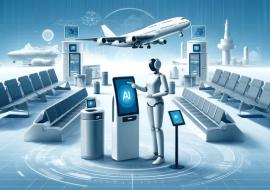
The Rise of Agentic AI in Travel

The travel industry has officially transitioned from the "hype" phase of generative AI to a high-stakes execution mode, with 61% of travel brands now actively testing or scaling agentic AI.
According to Phocuswright’s latest landmark report, Budgets, Barriers and the Race to Agentic AI, this new class of autonomous technology is reshaping the global tourism landscape by moving beyond simple content generation to executing real-world tasks such as booking, comparison, and complex problem-solving.
While the majority of the industry is in the experimentation phase, the divide between early adopters and laggards is widening. Data shows that 6% of travel companies have already achieved full-scale deployment, while another 22% are beginning to scale their operations. This shift toward agentic commerce—where AI agents act as digital proxies for consumers—is projected to manage up to 30% of travel bookings by 2030, fundamentally altering how brands maintain competitive advantage.
A primary catalyst for this rapid adoption is the emergence of the Model Context Protocol (MCP), an open-standard "translator" that connects AI models to external data sources like property management systems and loyalty programs. Over 50% of surveyed companies are currently implementing MCP or similar interoperability standards, effectively dismantling the information silos that previously hindered automated decision-making. By using MCP, brands can expose their data once, making it instantly accessible to a vast ecosystem of intelligent agents.
The economic incentives driving this technological transformation are substantial, with companies projecting an average ROI of 171% from agentic systems. In the short-term rental and hospitality sectors, operators report that up to 90% of day-to-day interactions, including guest messaging and scheduling, can be handled autonomously. These productivity gains allow leaner teams to focus on high-value growth while reducing operational costs by an estimated 30% in early implementations.
Despite the optimistic outlook, the industry faces significant adoption hurdles, primarily concerning data security and system integration. Nearly 41% of travel firms cite ecosystem integration as their top challenge, while others worry about the erosion of traveler trust if an agent makes a critical error. To mitigate these risks, many brands are increasing their AI training programs and seeking specialized consultants to build custom hybrid models that ensure first-party data remains under brand control.
The aviation sector remains a notable outlier, currently taking a more tentative approach compared to other consumer-facing industries. Research suggests that only 12% of airlines currently link AI directly to revenue growth, with many still layering new tools onto legacy systems rather than fully embedding them. However, as the broader industry embraces zero-touch travel, airlines are expected to follow suit to avoid being left out of the automated decision-making process.
As 2026 unfolds, the focus has shifted from "what AI can say" to "what AI can do." The successful integration of agentic workflows is no longer viewed as an optional add-on but as a core infrastructure requirement. For travel brands, the message from Phocuswright is clear: those who fail to modernize their data architectures risk becoming invisible to the digital agents that are increasingly making the world’s travel decisions.