Brown Tide in the Caribbean: Sargassum Crisis Threatens to Collapse Mexican Tourism
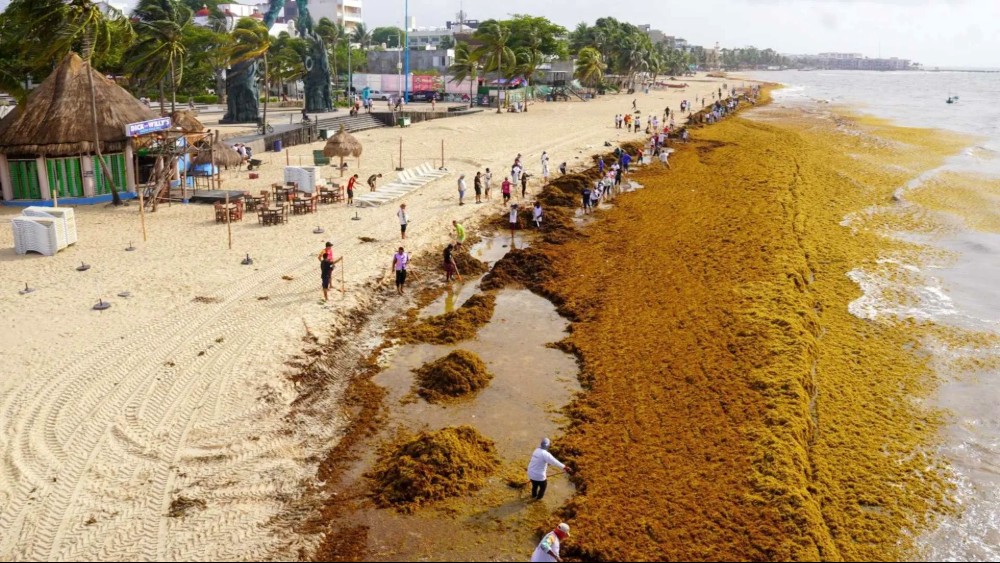
The turquoise waters of the Mexican Caribbean are facing their darkest challenge in decades. According to recent projections from UNAM’s National Earth Observation Laboratory (LANOT), nearly 40 million tons of sargassum are expected to circulate through the Atlantic Ocean this year—a record-breaking figure that dwarfs 2025 levels.
This massive biomass, which can double in volume in just 18 days due to global warming, has shifted from a seasonal nuisance to a permanent economic and ecological emergency for iconic destinations like Playa del Carmen and Tulum.
The scale of the arrival has rendered traditional containment barriers insufficient. As the macroalgae decomposes on the shore, it creates what experts call a "brown tide," a process that not only destroys the visual landscape but depletes water oxygen and releases toxic gases. Jorge Prado Molina, a researcher at UNAM, warned that the problem extends beyond aesthetics; the algae captures heavy metals such as arsenic and mercury, threatening to contaminate local aquifers if not disposed of in authorized facilities.
Economic Losses and Coastal Erosion
The financial toll on the service sector is devastating. Across Quintana Roo, local business owners and restaurateurs report a 50% drop in revenue as the accumulation of rotting algae drives visitors toward alternative destinations. In several high-traffic zones, maritime navigation has completely collapsed, leaving fishing nets and tour boats trapped in the dense vegetative mat.
Beyond the immediate economic crisis, beach cleaning efforts are causing irreparable collateral damage: coastal erosion. The use of heavy machinery to remove thousands of tons of sargassum inadvertently extracts vast amounts of sand. Critical points like El Recodo have reportedly lost up to 150 meters of shoreline in recent years. This loss of firm ground leaves multi-million dollar hotel infrastructure increasingly vulnerable to the impact of future hurricanes.
In the absence of a unified federal strategy, the private sector and academia are demanding more robust response protocols. While competitors like the Dominican Republic have implemented monitoring systems months in advance, Mexico’s reaction remains largely reactive. The scientific community is advocating for the use of high-resolution satellite imagery and drones to intercept sargassum patches in the open sea before they reach sensitive coral reefs and coastlines.
The battle against the "brown tide" is now the determining factor for the viability of the Quintana Roo tourism model over the next decade. Without massive investment in marine collection technology and proper waste management, the Mexican Caribbean risks losing its status as the "crown jewel" of international tourism. The industry warns that time is running out: either the tide is stopped at sea, or the region's economy will be suffocated under tons of marine weeds.