TSA Gridlock Intensifies as Federal Budget Impasse Enters Fourth Week

The "logistical paralysis" at major U.S. airports reached a critical flashpoint today as a partial government shutdown left thousands of Transportation Security Administration (TSA) officers unpaid for the second time in six months.
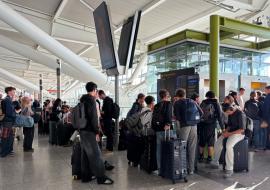
Following a failed Senate vote late Thursday, the funding gap for the Department of Homeland Security remains unresolved, triggering a massive spike in officer "call-outs" at high-volume hubs like New York-JFK and Miami. Travelers are currently facing security wait times exceeding four hours in some terminals, with reports of lines snaking deep into parking garages and public transit areas.
The staffing crisis is particularly acute at JFK International, where the call-out rate has skyrocketed to 21 percent, compared to a national average of just 2 percent. This "operational thinning" is happening during the peak Spring Break travel window, forcing several airlines to issue "travel waivers" and encourage passengers to arrive at the airport at least five hours before their scheduled departures. Many travelers, caught in the checkpoint gridlock, are missing flights despite following all standard protocols, leading to a "chaotic atmosphere" as terminal staff struggle to manage the overflow of frustrated voyagers.
Industry advocacy groups, including the U.S. Travel Association, have warned that the continued lack of funding is creating a "systemic risk" to the nation's aviation infrastructure. Beyond the immediate delays, the agency is seeing an exodus of veteran officers, with over 300 personnel having already resigned since the shutdown began in mid-February. This loss of "institutional knowledge" and security expertise could have long-term implications for passenger safety and terminal efficiency well after the budget dispute is eventually resolved by legislators.
For the 2026 traveler, the message is one of extreme preparation and "logistical defensiveness." Experts recommend checking "real-time wait apps" before leaving for the airport and, if possible, utilizing secondary regional airports where the staffing impact may be less severe. The situation has highlighted the "fragile dependency" of the travel sector on federal stability, reminding the public that even the most advanced biometric screening technology cannot function without a properly compensated and motivated workforce.
The Department of Homeland Security briefly considered suspending TSA PreCheck and Global Entry services to consolidate staff into standard lanes, though that decision was reversed following a massive public outcry. For now, the "expedited" lanes remain open but are offering little relief, as wait times for pre-screened travelers have also climbed past the one-hour mark in several cities. The industry is now looking toward the weekend with "extreme caution," as a resolution to the funding impasse appears nowhere in sight.
As the day progresses, several airports have begun deploying "hospitality teams" to distribute water and snacks to those stuck in the security bottleneck. While these gestures are appreciated, they do little to solve the underlying crisis of confidence that is currently clouding the U.S. travel market. For those with flexible plans, travel advisors are suggesting a "wait-and-see" approach, as the travel experience in 2026 continues to be defined by a "perfect storm" of political and operational challenges.